
When I first of heard of “Soft Landings” from Doug Tallamy, it conjured images in my mind from the mail order catalog Soft Surroundings – soft bed linens, cotton towels, and silk pajamas, offering comforting slumber. But of course Doug Tallamy was talking about something else altogether. By providing soft landings, i.e. dense plantings of native plants beneath our landscape trees, we are providing a safe and comfy place for insects and wildlife to live and safely overwinter. Imagine caterpillars falling off of trees into soft landings to complete their life cycle, in or beneath the native plants and leaf litter. Then imagine the alternative – the rakes, the blowers, the mulching mowers. It’s not pretty!
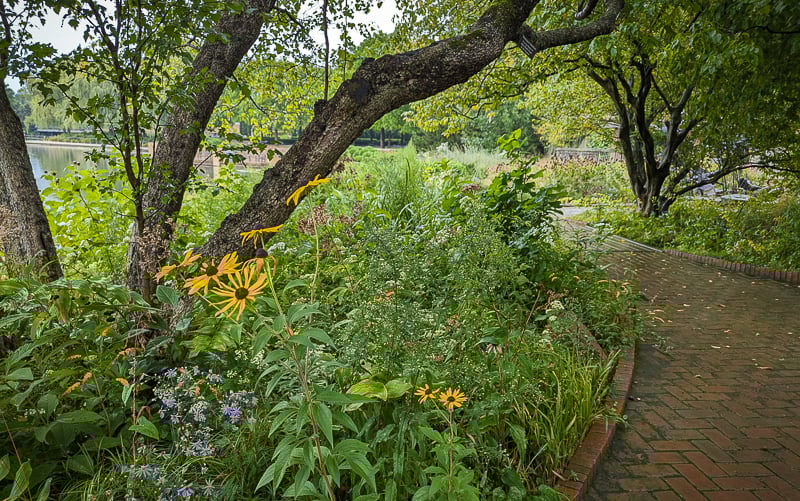
Heather Holm, the lauded environmental writer who focuses on pollinators, has written extensively about the practice of creating and nurturing soft landings on her website, explaining in detail how soft landings provide invaluable habitats for moths, butterflies and beneficial insects. Click on this link to visit her page on soft landings. She does a beautiful job of describing how and why soft landings are beneficial, and includes a gallery of photos for inspiration. She also includes guidance on how to build a soft landing without harming the roots of the canopy tree.
In one of Margaret Roach’s Virtual Garden Club classes (non-public, posted behind a firewall, unfortunately), “Spring 2.0: Eco-Cleanup & Beyond,” Rebecca McMackin shared pictures of a site beneath a big oak tree in an urban space, before, when the earth was eroded, compacted and bare – not a soft landing by any stretch of the imagination, and after, when the space was filled with native flowers and understory plants. The differences are stark, both from an ecological perspective in that the understory plantings prevent erosion and provide habitat, but also in terms of beauty.
Beauty and ecology are both important elements of gardening. Ornamental landscapes are frequently built with non-native plants that are beautiful, but that can be invasive and/or create environmental wastelands. However, it’s easy to establish soft landings that are both ornamental and ecologically beneficial. Check out this YouTube video by Margaret Roach, “Making Garden Mosaics: Underplanting Trees and Shrubs.” She focuses on the design elements of creating beautiful understory plantings. It’s up to you to choose native plants!
The ecological benefit of soft landings is greatest when established under keystone trees – native oaks (quercus), cherry and plum trees (prunus), willows (salix), and birch (betula). However, we must work with what we have. I have a few dogwoods planted around my property, mostly native and one Kousa (I couldn’t resist), and I’ll be taking the time this winter to design soft landings beneath each of them. Identifying plants that are suitable is easy, with all of the great resources we have available in the internet. Here are some of the resources I’ll be using to identify native wildflowers, sedges, and ferns that will thrive beneath my trees –
- Native Plant Trust – https://plantfinder.nativeplanttrust.org/Plant-Search
- Heather Holm’s list (of course!) – https://www.pollinatorsnativeplants.com/softlandings.html
- UCONN’s plant database – https://plantdatabase.uconn.edu/
- Izel Native Plants – https://www.izelplants.com/blog/soft-landings/
Ecological garden design can be challenging – establishing native plantings that are aesthetically pleasing, coordinating shades of green and pops of color, varying textures and heights that draw you eye through the garden. It’s also incredibly satisfying. Those of us with dirt under our fingernails know first-hand just how rewarding it is when it finally comes together – creating calming and peaceful soft surroundings for humans, while at the same time increasing biodiversity and enhancing our collective ecosystem. The practice of creating safe and cozy soft landings in support of pollinators is an easy and effective way to achieve this.
– Melinda
P.S. Just as I was finishing this post, I got an email from Margaret Roach about her Fall 2025 class series. Lo and behold, Heather Holm is on the calendar, and she’ll be discussing Soft Landings! The webinar will be presented November 13, 2025, 1-2:30 PM Eastern. Here’s a link to the class description – “Keystone Plants and ‘Soft Landings’ Plantings for Native Bees.” (You’ll have to scroll down)
 Ashford Pollinator Pathway
Leave a Reply